
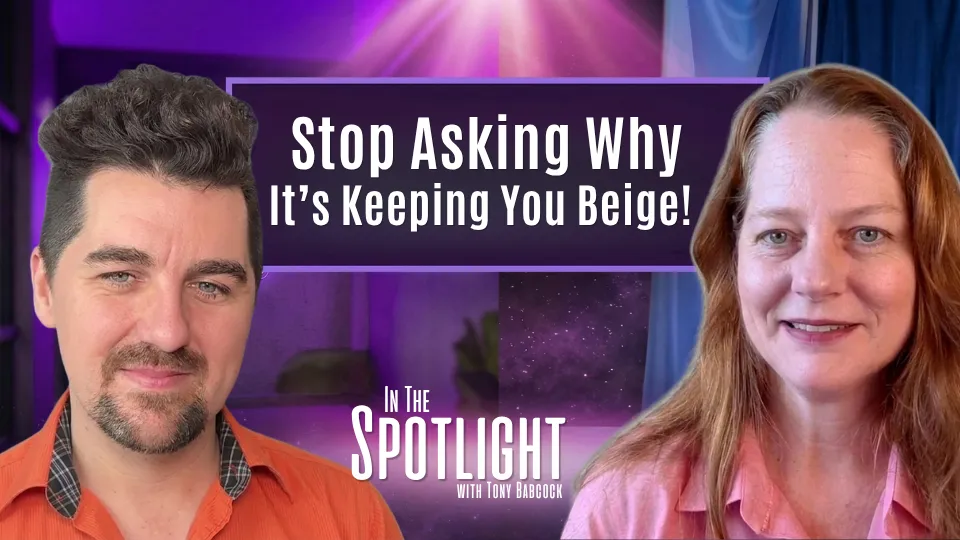
Reasons Are Excuses in a Fur Coat: Why the Most Popular Self-Development Question Might Be Keeping You Stuck
Let me ask you something.
When was the last time you asked yourself “why” and actually got a useful answer?
Not an excuse dressed up in language. Not a story you’ve been telling yourself for years. An actual answer that moved you forward.
I recently sat down with Katie Kleuber, author, Perspective and Story Alchemist, and the woman who spent 20 years untangling oil and gas chains of title before realizing her real calling was untangling how people think. And she made me question the question.
“Why keeps us beige.” Katie Kleuber |
That’s not a throw-away line. That’s the whole episode in four words.
The Analogy That Started It All
Before we got into philosophy, we started with Twinkies.
Early in her oil and gas career, a coworker asked Katie: what’s the difference between a lease expiring and a lease terminating?
Her answer, invented on the spot that morning: milk expires. Twinkies only terminate if you eat them or microwave them. They don’t just expire on their own.
The coworker couldn’t put creamer in her coffee for months.
This is how Katie’s brain works. It doesn’t explain. It reframes. It finds the angle that makes something not just understood, but unforgettable.
She’s been doing it her whole life, moving across Alaska, Colorado, Texas, North Carolina, Grand Cayman, California, and beyond, making friends fast, reading people quickly, building deep connections in short windows. The constant movement trained her to improvise, adapt, and overcome. It made her malleable. It made her see.
She calls herself a Perspective and Story Alchemist. Not because it’s a catchy title, but because it’s accurate. She takes how you’re looking at something and shifts it just enough that you see something completely different.
Like a kaleidoscope, she told me. You’re not telling people how it is. You’re just turning the dial a little.
The Problem with Why
At some point in the conversation, Katie brought up something that stopped me cold.
She had been in real estate for a while, working toward her license. And every training, every coach, every “success mindset” framework pushed the same thing: know your why. What’s your big reason to get out of bed in the morning?
Katie’s answer: she was done sleeping.
The trainers didn’t like that. They kept pushing. They never got to the real question.
“Why is never the question you’re really asking,” she said.
And once she said it, I couldn’t unhear it.
Why puts the answer outside of you. Why stalls action. Why begs for reasons. And here’s the line that made me want to put the microphone down:
“Reasons are excuses in a fur coat.” Katie Kleuber |
They get all dressed up. They sound responsible. They sound reflective. But reasons are excuses wearing something expensive, and they keep you standing in the same place asking the same questions.
Does a fireman ask why the fire started? No. They ask how. They look for causes. They move.
Does a first responder at a car accident stand there asking why this happened? No. They assess. They act.
“Why also begs for reasons,” Katie said. “And reasons are excuses in a fur coat.”
Even asking why to “get to the root” faster, as I tried to defend, doesn’t actually get you there. The answer you arrive at via why is still a band-aid. It is not the core. Because why always, eventually, lands somewhere outside yourself, dressed up as an explanation.
The Alphabet Reframe (She Made This Up Live)
Then she did something that I’m still chewing on.
She looked at the conversation and said: “B, to be, or just the letter B, is only the second letter in the alphabet. Y is the third from the last.
Where do you want to stand in the conversation with yourself?
She came up with that in the moment. No notes. No preparation. Just the way her brain works.
And she kept going.
“Why is the rear-view mirror,” she said. “Why is it so small?”
Because you’re not meant to spend most of your time looking backwards. The rear-view mirror is small by design. It’s useful. But it’s not what you steer by.
If you’re spending most of your self-inquiry in the why, you’re driving by rear-view.
What to Ask Instead
So what do you do when you want to ask why?
Katie’s process is simpler than you’d expect. When a why question comes up, she writes it down. Then she asks: if why is not running this question, what is?
That’s the shift. From why to what. From spinning to steering.
She also uses the princess and the pea as a frame. The pea, the actual question you’re trying to reach, is at the bottom. All the mattresses on top are the questions stacked around it. Why keeps piling on mattresses. What and how start pulling them back.
And when you’re genuinely stuck, when you can’t even figure out where you want to go, she offered these:
What lights you up?
If you can’t answer that: what dims your light?
If you can’t answer that either: what are three things that worked today?
Start there. The small incremental steps get you looking toward bigger questions. And you can’t get to London by sitting on a park bench. But you also need to figure out which direction east actually is.
The Beige Problem
Which brings us to the metaphor at the center of everything.
Beige is the color you get when you mix all the colors and add a lot of white. It’s neutral. It’s inoffensive. It’s what happens when you’re trying to be everything and nothing at the same time.
In housing design, beige was the safe choice for a generation. Then gray replaced it. But the impulse was the same: let’s not commit to anything. Let’s blend. Let’s fit in.
And when you keep asking why, Katie said, you keep mixing your colors into the same pot. The result, inevitably, is beige.
“Why keeps us beige,” she said.
But beige isn’t the ending. It’s the starting point.
“Put two beiges next to each other,” she told me, “and you start noticing the differences between them.” And if you try to mix the color beige, you realize how many colors actually go into it. There is complexity inside the neutral. There is possibility inside the uncommitted. Beige is just where you start, not where you have to stay.
The Permission Slip
This is also what her book is about.
Beige Unless That’s You is a 52-prompt seasonal journal. One line per page. Not meant to be read cover to cover. Just open it, read something, put it away. Let it interrupt your default setting.
She started it as a practical hack book, the kind of thing she’d been giving away for free in conversations for years. Then she read it back and realized it was beige. It had less seasoning than chicken soup for the soul.
So she rewrote it. Playful. Surprising. The kind of writing that makes you tilt your head and sit with something.
On air, Tony picked page 13. She read it:
“You won’t know if it’s an anthill or a mountain hill until you reach the top.” Beige Unless That’s You |
Then page 42:
“Does the door blame you for bumping into it?” Beige Unless That’s You |
That second one, she noted, is a why question in disguise: why are you letting the little things bother you? But answered by an inanimate object that simply doesn’t care. Inanimate objects don’t carry the weight you’re carrying. They just exist.
Permission to do the same.
What Coming of Self Actually Means
Near the end, I asked Katie what “coming of self” means in one sentence.
She asked for a run-on sentence. I gave it.
Here’s what she said:
“The coming of self is more than coming of age. Age is a defined number. Self is ever-present. There are things in our lives that bring us to a new awareness of ourselves. The death of a parent, the loss of a job, the loss of a child, the first time owning a home, getting married. All of those are moments when you come to know yourself a little bit better, a little bit differently. A change. Those are the things I want to look at.” Katie Kleuber |
Age is just a number. Self is where the real story is.
And the questions you ask yourself along the way, what, how, where, who, so what, shape how much of that story you actually get to write.
Listen to the full conversation with Katie Kleuber on In the Spotlight: Stop Asking WHY: Perspective Alchemist Katie Kleuber on Beige, Better Questions & Permission
Find her books: Beige Unless That’s You at museunleashed.com/beige and Twilight Embers at museunleashed.com/twilight-embers.
Follow Katie on Instagram: instagram.com/author.katie_pink
You always have a choice; to go within, to listen, and to own your spotlight.